
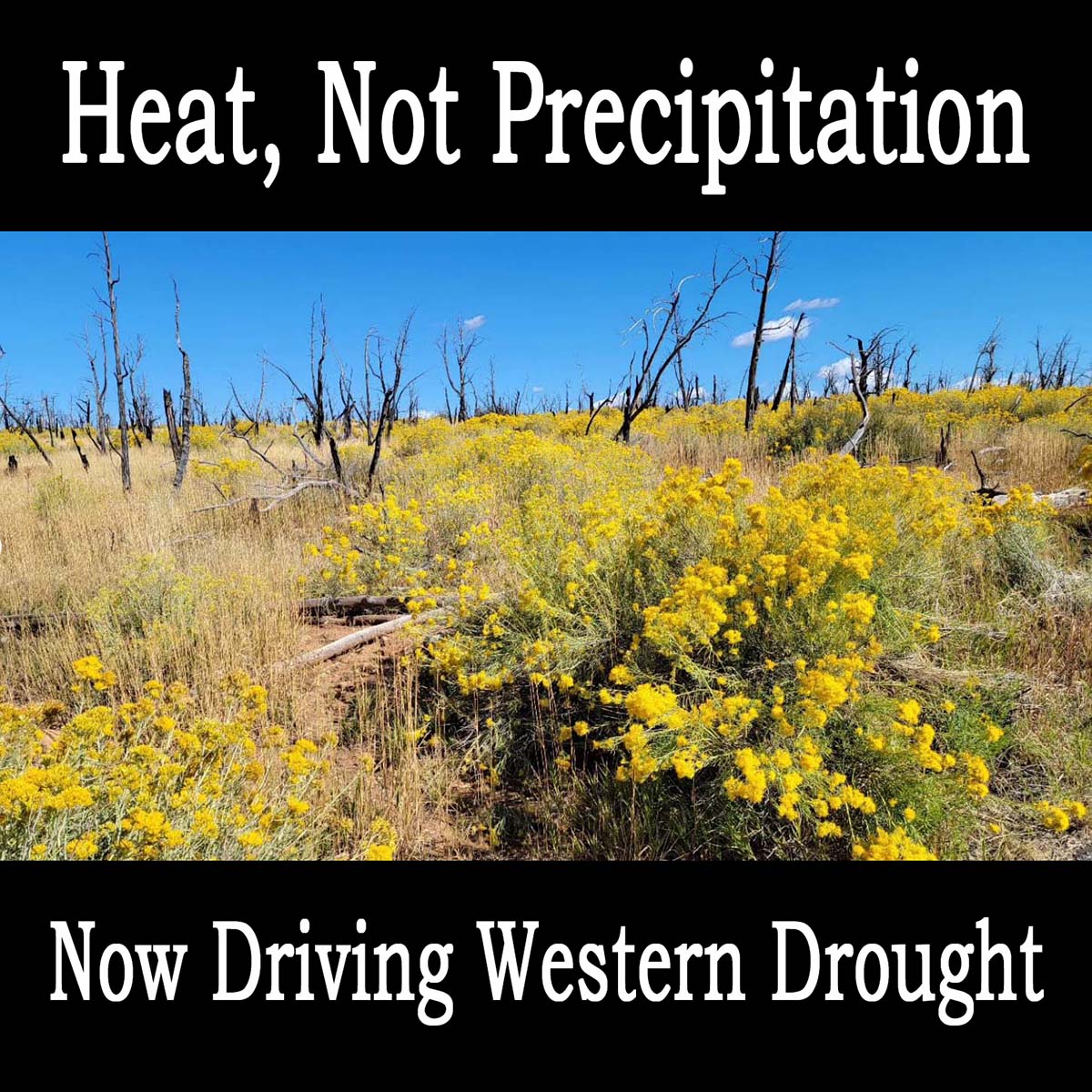
Heat Now Drives Western Drought, Not Precipitation… Forget about future drought extremes on a warmer planet. Droughts today have exceeded the evolutionary boundaries of most if not almost all of our world’s ecologies. This means their collapses are baked in, where new species and mechanisms tolerant of the warmer and drier conditions, replace the old species and mechanisms as they collapse. Droughts do not have to become worse for these collapses to be realized with the results of the release of millennia of stored carbon as greenhouse gases. This is over ten times what humanity has released in all time from agricultural practices and fossil fuels.
The risk is that much of these emissions will occur in decades rather than the centuries that it took humans to muck up our climate, and once a system begins to degrade, it’s ability to absorbed more carbon is limited and quickly flips to emissions where today, most of our degraded systems (tropical, boreal, high altitude forests, permafrost, ice sheets, sea ice, etc.) have already flipped to emissions or collapse of physical functioning. Literally, once degradation to a system begins, that system almost always collapses unless the thing that caused the degradation to begin is removed before the time that the systems is so degraded it cannot self-restore even if the degradation factor were removed. This time is called the “point of no return” in climate science literature on tipping, and in most systems with degradation already active, the timeframe for restoring our climate is about mid-century.
The modelling suggests the Western U.S. drought of 2020-2022 was a 1,000-year event in our old climate, a 60-year event by mid-century and a 6-year event by the late 21st century. But modeling is understated, almost entirely across the board, because of unknowns in the rate of collapses and emissions of previously stored carbon as greenhouse gases, and from other very critical issues like albedo, or the reflectivity of landforms and vegetation. Loss of reflectivity is illustrated by two things: loss of snow and ice cover, where snow reflects up to 90 percent of the sun’s light harmlessly back into space, and vegetation, earth, rocks and water absorb up to 90 percent of sunlight and change it into heat where it can be trapped on Earth by the greenhouse effect. The other is more subtle but still vitally important. Loss of tree cover exposes a darker forest floor, that absorbs more light and increases local warming, using up vital water supplies more rapidly, creating less cooling from evaporation, and further reducing the forest’s ability to regenerate where this ability is already degraded and failing in some forests.
The bottom line then is that, Earth systems degradation and activation of climate tipping elements are one and the same. Without restoring our climate -cooling from today- back to within the evolutionary boundaries of our forests, their ongoing degradation does not stop until the forests have collapsed, with the results of those natural feedback carbon emissions of greenhouse gases as the forests decomposes and fails to regenerate, that are more than ten times all human emissions, ever.
Abstract, “Historically, meteorological drought in the western United States (WUS) has been driven primarily by precipitation deficits. However, our observational analysis shows that, since around 2000, rising surface temperature and the resulting high evaporative demand have contributed more to drought severity (62%) and coverage (66%) over the WUS than precipitation deficit. This increase in evaporative demand during droughts, mostly attributable to anthropogenic warming according to analyses of both observations and climate model simulations, is the main cause of the increased drought severity and coverage. The unprecedented 2020–2022 WUS drought exemplifies this shift in drought drivers, with high evaporative demand accounting for 61% of its severity, compared to 39% from precipitation deficit. Climate model simulations corroborate this shift and project that, under the fossil fueled development scenario (SSP5-8.5), droughts like the 2020–2022 event will transition from a one-in-more-than-a-thousand-year event in the pre-2022 period to a 1-in-60-year event by the mid-21st century and to a 1-in-6-year event by the late-21st century.”
Zhuang et al., Anthropogenic warming has ushered in an era of temperature-dominated droughts in the western United States, Science Advances, November 6, 2024.
https://www.science.org/doi/epdf/10.1126/sciadv.adn9389
Image: Regeneration fail of the pinyon pine/juniper woodland atop the Mesa’s of Mesa Verde National Park. About the turn of the century, fire enhanced by drouyght, heat, beetle kill and water stress mortality, burned most of the mesa tops at Mesa Verde. After 20 years, their was zero regeneration. It is just too hot, too dry from heat, not lack of precipitation, and the fires today are burning so severely with dryer fuels that the seedbank in soils is incinerated.
Pinyon Juniper Woodlands in Mesa Verde are not regenerating after fire…
“Pinus edulis–Juniperus osteosperma (pi˜non-juniper) woodlands in the southwestern United States are of high conservation value and are threatened by changing climate and increasing frequency of large, severe fires. We followed vegetation development after three recent fires (1989, 1996, and 2000) in Mesa Verde National Park (MEVE). Two types of pinon-juniper vegetation are found in MEVE: sprouting woodlands (SPW), dominated by species that resprout after injury, and obligate seeding woodlands (OSW), dominated by non-sprouting species. SPW stands showed greater resilience than OSW in terms of recovery of pre-fire structure and species composition, and vulnerability to invasion by nonnative plant species. After all three fires, plant cover increased more rapidly in SPW stands; all major pre-fire species were present within 2 y, and fewer nonnative species became established. Plant cover developed more slowly in OSW stands; nonnative plant species proliferated, in places being more abundant than the newly germinating native species. No reestablishment of pinon or juniper trees has been observed. If current trends persist, some portions of the burned SPW may be converted to a persistent shrubland type, while much of the burned OSW may be converted to a persistent, novel herbaceous vegetation type with a large component of nonnative species. Similar changes after fire can be expected in pinon-juniper woodlands like those in MEVE, which are widely distributed throughout the region.”
Floyd et al., Effects of Recent Wildfires in Pinon-Juniper Woodlands of Mesa Verde, Bio One, February 2021.
(Researchgate – Free subscription required) https://www.researchgate.net/publication/349013945_Effects_of_Recent_Wildfires_in_Pinon-Juniper_Woodlands_of_Mesa_Verde_National_Park_Colorado_USA