Work from Leeds, Durham University, the Byrd Polar Research Center and University of California, Irvine, have taken a deeper look into melt lakes forming on the Greenland Ice Sheet. There modeling was for melt lake formation in the melt zone. The “melt zone” is that area around the edge of the ice sheet that melts…
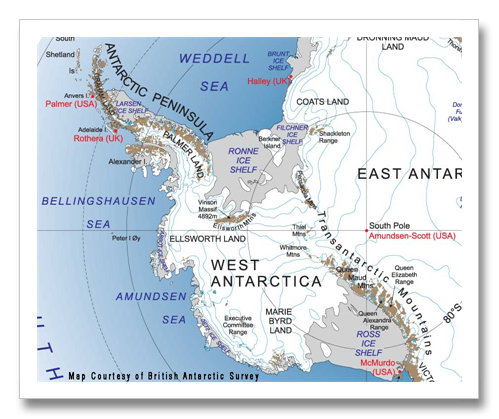
Researchers at UC Cal Irvine and NASA, using four different measurement techniques, have found that West Antarctica’s ice loss has tripled since 1992. The measurements looked at glaciers discharging to a west central location of West Antarctica called the Amundsen Sea Embayment (see Amundsen Sea in the map on the right). This could possibly be…
This research, funded by the Swiss and U.S. National Science foundations, looked at Greenland Ice Sheet movement in the melt zone that extends inland 50 to 100 miles from the edge of the ice sheet. This is where melt water moves through the crevasses in the ice sheet, then flows down to bedrock and lubricates…
The North Atlantic is warming and Greenland’s ice loss has quadrupled in the last 20 years. Warm water is getting under the floating edges of outlet glaciers and causing thinning which in-turn causes the glaciers to speed up. New research has identified another and possibly new dimension to the increase of outlet glacier flow that…