
Continuous El Nino Conditions Due to Human-Caused Climate Warming
by Bruce Melton PE
ClimateDiscovery.org
ClimateChangePhoto.org
El Nino is not just periodic any longer. Current ocean warming has created continuous El Nino conditions. When NOAA tells us it’s an El Nino in the Pacific, this reflects conditions that are “warming above average,” where the average ocean temperature includes warming already experienced from climate change.
This is a conundrum of the intersection of climate science and meteorology where averages conditions for temperature, rainfall and etc., are recalculated every ten years to reflect current conditions. When the television meteorologists tells us that the temperature is “normal” for the forecast today, this means that it is normal with the last average calculation period, not normal from times past in pour old unchanged climate. This NOAA weather data averaging includes several degrees F warming. In the past, when our climate was not radically changing, this made sense but today, this outdated strategy tells us civilians that everything is fine because the temperature is normal, when in fact it is several degrees F above the actual normal from our old climate. The same thing is happening with El Nino weather discussions.
Our oceans have absorbed about 90 percent of the excess heat generated by human-caused climate change. Like anything climate change, our oceans’ warmth is at record levels and the warming is accelerating more rapidly every year. We hear this constantly – that climate change is increasing, accelerating, getting worse faster, that warming and effects are now nonlinear.
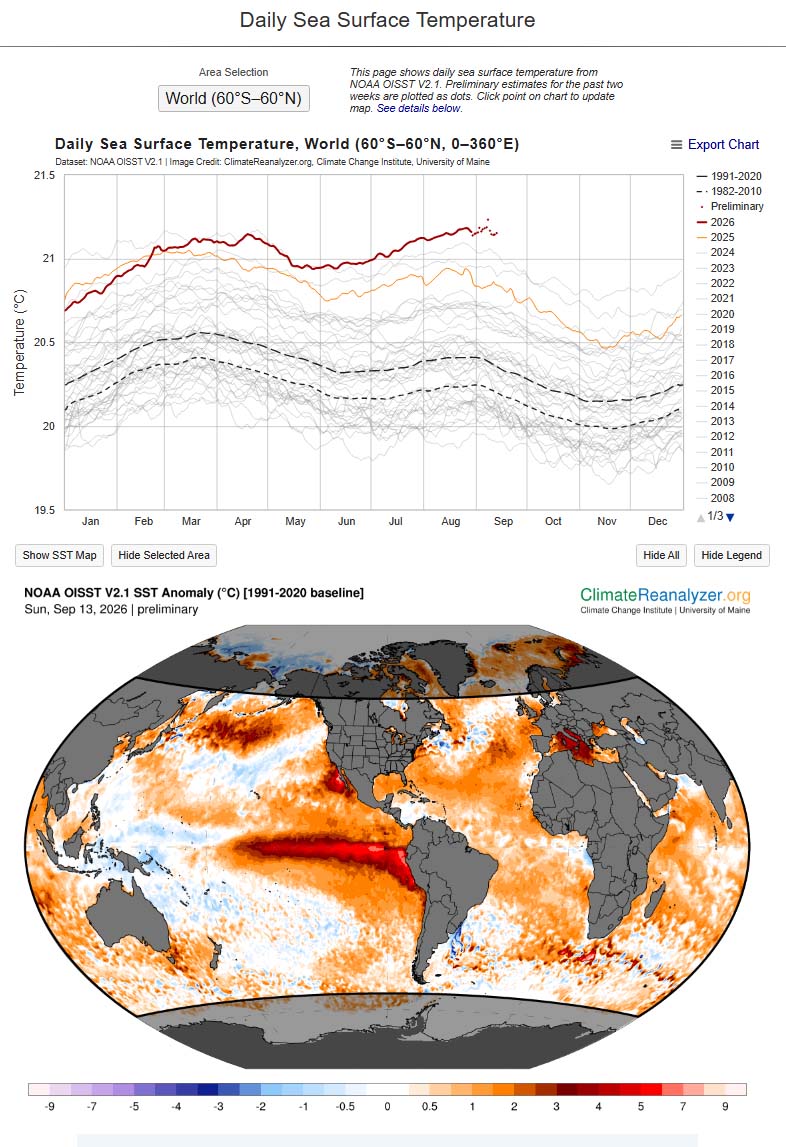
What is not said is that current ocean warming from 60 degrees north to 60 south is over 1 degree C 1.8 degrees F) since 1981. This amount of warming represents a moderate El Nino. A weak Nino starts at 0.5 degrees C warming.
See the interactive ocean warming graphic at the Climate Change Institute here – https://climatereanalyzer.org/clim/sst_daily/?dm_id=world2
To interact, move your mouse up and down the years legend to highlight individual years. Notice how at least half of ocean warming has occurred since 2010. Then notice how a quarter of the warming has occurred since 2020. Does this mean warming is accelerating? Yes. This is not a defining metric, as our oceans move heat around in upwelling and downwelling currents that change the apparent rate of ocean warming, but it is meaningful nonetheless and starkly reveals one of the most important things about climate change: it starts small, then nonlinearly ramps up in speed and effects. At some point the pace of acceleration in many Earth systems reaches a point of collapse.
We are already into this collapse phase of climate change. Earth systems degradation is the first part of collapse and on average, all Earth systems globally are now in degradation. Ask yourself then, what happens to a system when it is degrading if the thing that caused the degradation to begin is not removed? This is what academics refer to as climate tipping or tipping elements. These elements are none other than our Earth systems: oceans forests, ice sheets, the hydrologic cycle, etc. Unless we remove the degradation agent (warming effects), most earth systems will see a point in their degradation where the system becomes so impaired that it can no longer self-restore if the degrading agent is removed. This is called the point of no return and it defines classic “tipping” in the literature, where many if not most Earth systems will irreversible collapse about mid-century.
The big deal with tipping is environmental services. Once degradation begins, environmental services like carbon sequestration become impaired and quickly reverse in the case of carbon storage. This means that the system no long stores greenhouse gases; they flip to emitting. This is happening right now on average across Earth’s forests with tropical, boreal and high altitude forests leading the way. (This is much of what we film at the Climate Change Now Initiative btw – See ClimateChangePhoto.org for images of Earth systems degradation across North America). Millennia of stored greenhouse gases are at risk and accelerating warming create cascading feedbacks across Earth systens that accelerate emissions beyond the initial warming acceleration.
Importantly, future emissions elimination does nothing to remove the warming effects that have caused this tipping to begin. Only cooling our climate by removing greenhouse gases already emitted and resident in the sky, or through temporary cooling like we have been doing with naturally occurring sulfur in fossil fuels for 200 years; only removals and cooling can cool our climate. Future emissions only reduce future warming. Future emissions elimination can reduce the amount to removals and cooling that is required to stop tipping before the point of no return, but the amount of future warming’s reduction of these two things is relatively small compared to the 200 years of emissions that remain in our sky.