
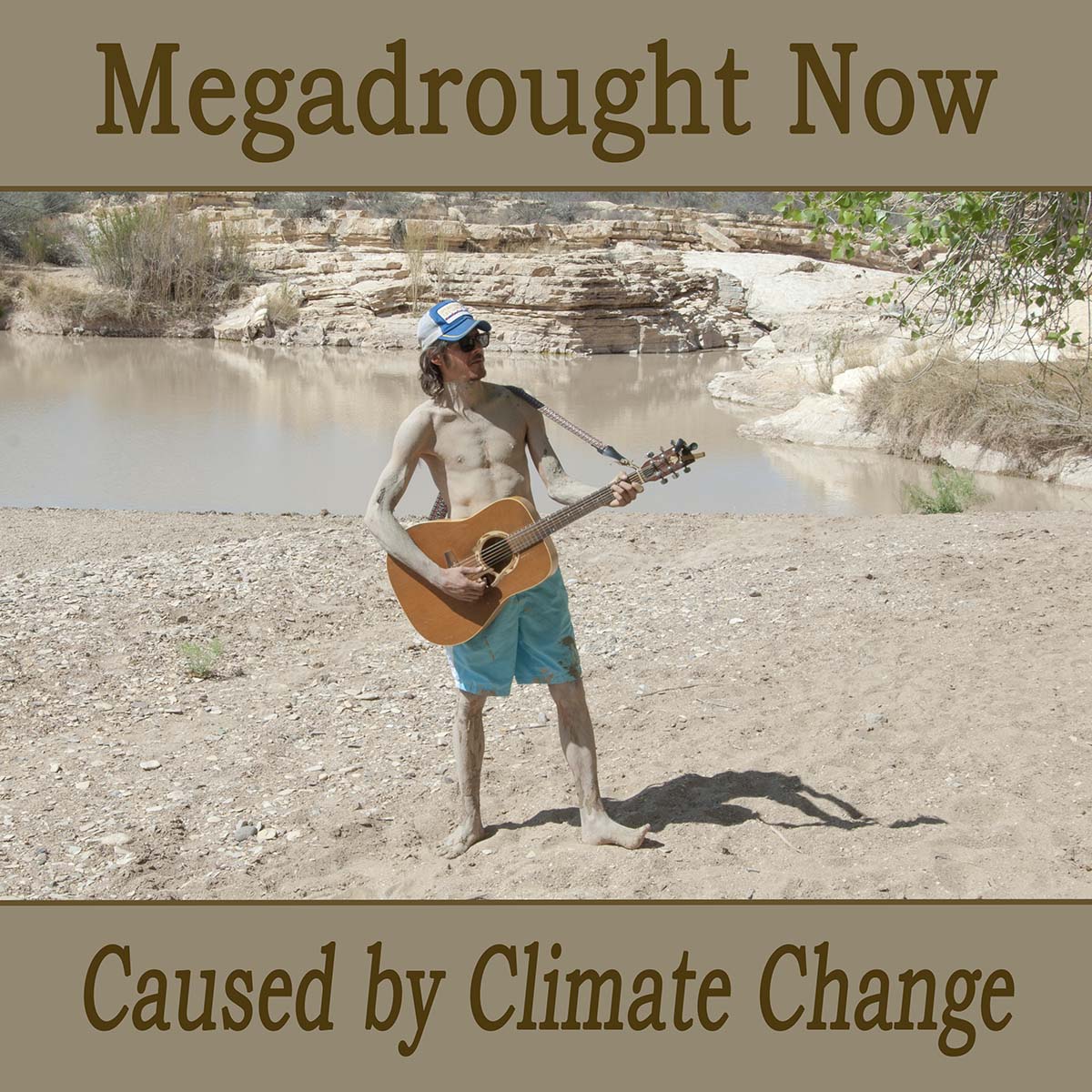
 Only cool mud remains
Study Finds that 42% of the Megadrought in the U.S. Southwest Has Been Caused by Climate Change; and Texas Too
Our climate has crossed evolutionary boundaries of Earth systems
Degradation has begun, that
emissions reductions alone cannot stop
First published on Drought.gov in 2022. See https://www.drought.gov/research-spotlight-climate-driven-megadrought from 9/15/2026
This study is reviewed on Drought.gov. Apparently, the science deniers have overlooked this one and it has not been deleted, yet. The review states, “Human-caused climate change is responsible for about 42% of the soil moisture deficit since 2000, the paper found. One of the primary reasons climate change is causing more severe droughts is that warmer temperatures are increasing evaporation, which dries out soil and vegetation. From 2000 to 2021, temperatures in the region were 0.91 degrees Celsius (about 1.64 degrees Fahrenheit) higher than the average from 1950 to 1999.”
Another study led by Texas State Climatologist tells us, “Projections indicate drier conditions during the latter half of the 21st century than even the most arid centuries of the last 1,000 years that included megadrought. The study was conducted by members of the Texas Water Research Network, a water research hub at the University of Texas Environmental Science Institute, and led by the Office of the Texas State Climatologist.”
Drought.gov Press Release
Nature article
In 2026, the megadrought has become much worse.
From NPR | By Bryce Dix, Published September 14, 2026
The megadrought on the Colorado River has been getting a lot of headlines lately, but another major western river, the Rio Grande, is having its driest year on record. There’s currently no water in the riverbed where it passes through Albuquerque. This is only the third time in 40 years that’s happened. Bryce Dix with member station KUNM reports on extraordinary measures being taken to save trees that depend on the river.
BRYCE DIX, BYLINE: Just before noon on a late summer day, what’s supposed to be the Rio Grande in Albuquerque is instead sandy, dry and dotted with young, low-growing shrubs and bits of trash. Massive cottonwood trees line both banks, providing coveted shade and a rare streak of green. Kim Eichhorst leads a University of New Mexico research program that closely watches over this forest – or as locals lovingly call it, the Bosque.
KIM EICHHORST: We’re in a time where we’re seeing less and less snowpack. It’s evaporating early. So that is critical for a lot of our native riparian species, like the cottonwoods and the willows.
DIX: The browning vegetation hasn’t seen much water for about three months, until now.
(SOUNDBITE OF FLOWING WATER)
DIX: Alarmed by the unprecedented drought, conservationists like Paul Tashjian spearheaded an effort with local agencies to rewet the river. They released 650 million gallons of Colorado River water from a reservoir into the Rio Grande. The goal is to save Albuquerque’s century-old cottonwoods, whose roots rely on the river to survive.
PAUL TASHJIAN: It’s kind of existential, what we’re seeing out there. I don’t think we’re going to see a complete dieback, but we might end up with 30% less trees come next year.
See the full story here, podcast too
Population Growth, or Climate Change?
This is all so counterintuitive when one considers the actual water use from the Colorado River. Widespread outreach would have us believe that population growth is using far more water, and in some outreach, is responsible for the water shortage in the river. The reality though, is that around the turn of the century when this megadrought began; when climate change effects began to overwhelm our historic understanding of our world, When warming effects exceeded the evolutionary boundaries of our Earth’s systems, conservation measures were implemented that have resulted in the total water use from the Colorado River falling, not to increasing with an increasing population.
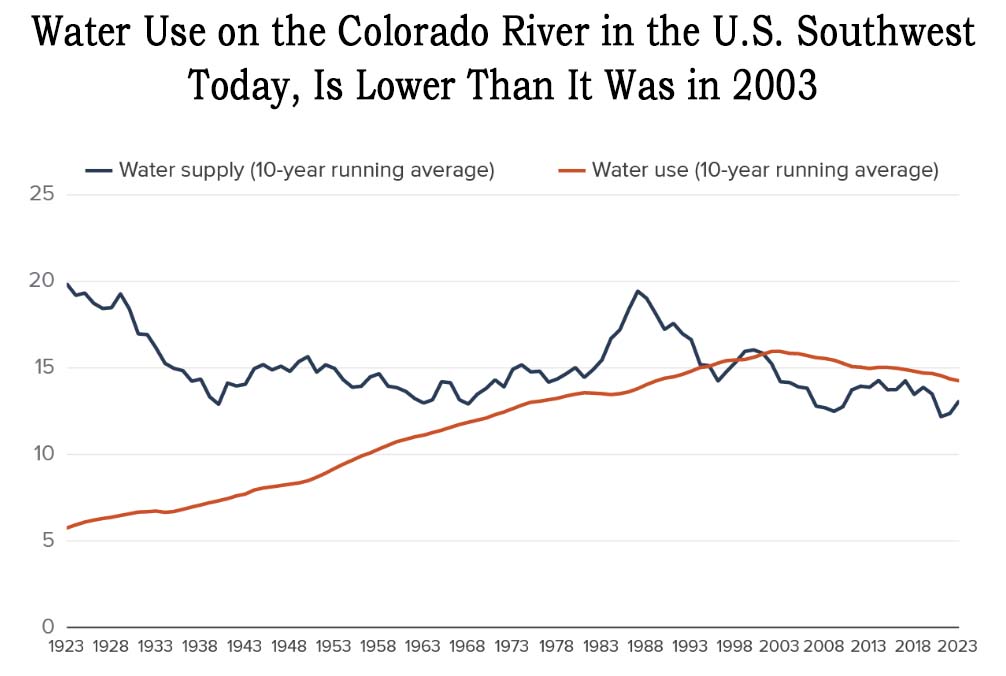
Because of efficiency measures begun when this current climate change-caused megadrought began around the turn of the century, water use from the Colorado River has actually declined, despite population growth of 30% from 2000 to 2025, from 35 million to 45.5 million. Graphic from Public Policy Institute of California.