Damage from wind, bark beetles and wildfires have increased in Europe’s forests since 1900. This report quantifies these damages and models then out to 2030 for the purpose of evaluating forest management techniques on limiting damages. There work finds that management techniques will have a difficult time keeping up and relative to the overall European…
Canadian boreal forest mortality is already ten times higher than normal. In a similar study in the Western U.S., five times higher mortality than normal was found. The Canadian boreal forest is that northern area of Canada where almost nobody lives. It extends north through some of the wildest lands ever known to the arctic…
As I have been saying in the first two installments of this series, climate change is already much more extreme than most scientists have been predicting. This is mainly because the majority of predictions are based on the “most likely” emissions scenario and because we have not reduced our emissions like climate scientists told us…
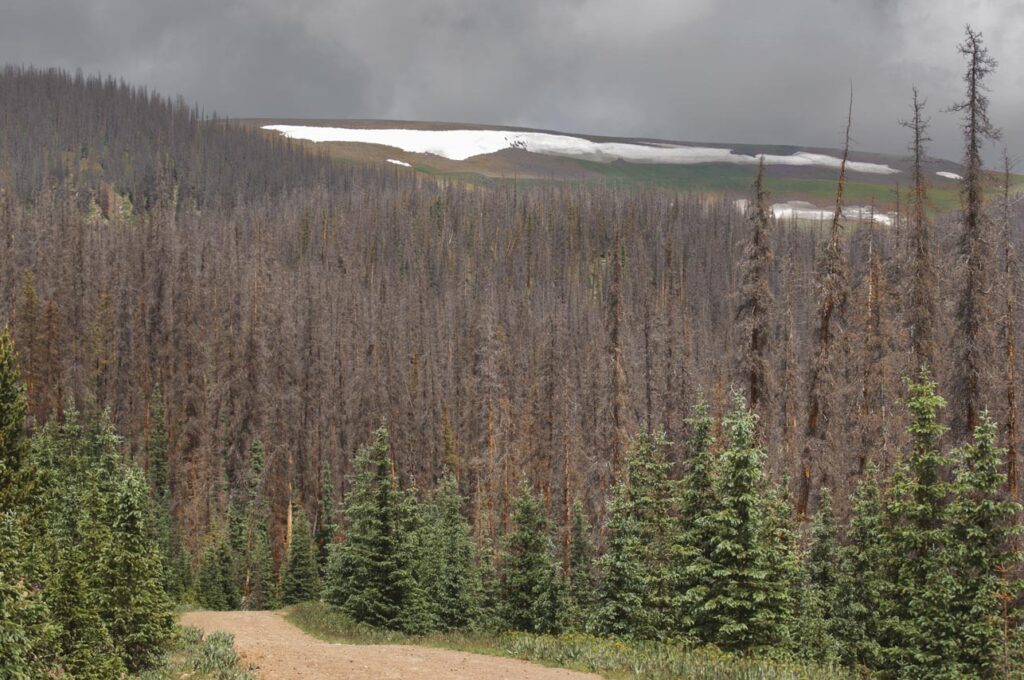
It’s been happening for more than a decade. Drought, insects and disease are recreating the landscape of western North America. A paper out of Oregon State tells the story: “A huge “migration” of trees has begun across much of the West due to global warming, insect attack, diseases and fire, and many tree species are…
“The death of the forests – primarily comprised of conifers, which are distant relatives of today’s pines and firs – was part of the largest extinction of life on Earth, which occurred when today’s continents were part of one supercontinent, Pangaea. The so-called Permian extinction likely was triggered by immense volcanic eruptions in what is…
A broad spectrum of ecological indicators are all headed in a negative direction in the Great North. Warming has been identified as the culprit. The more it warms, the greater the impacts. The forests that have evolved with the climate in the North are not at all adapted to the climate up there now. Widespread…
Abstract: “During this decade, the Amazon region has suffered two severe droughts in the short span of five years – 2005 and 2010. Studies on the 2005 drought present a complex, and sometimes contradictory, picture of how these forests have responded to the drought. Now, on the heels of the 2005 drought, comes an even…
The World Wildlife Fund says that we could lose 57 billion acres of forest to development and agriculture by 2050. There is NO mention of loss of forests due to climate change in their new report. Even though, 64 million acres are dead from a climate change induced insect attack in the North American Rockies….
One of the interesting things that this study has discovered is that decreased growth rates due to drought stress is not necessarily related to soil moisture. Forests with normal soil moisture can experience drought stress from excessive heat. It’s like their vascular system evolved without excessive heat and therefore the capacity of the trees vascular…
This is yet another climate change impact happening before it was supposed to – a big one too. Findings from this team led by a biologist at the University of Guelph, Ontario, Canada, and including scientists from the USGS and the US Forest Service tells us that the black spruce forest of Alaska (much of…
In 2005, the Amazon had a one-hundred year drought. An event like this is basically supposed to be once in a hundred-year occurrence. Five years later they had another. But the 2010 drought was likely more than half again as extreme as the 2005 drought. We can not say with scientific certainty that because we…
Two US Geological Survey researchers published a paper in the Proceedings of the National Academy of sciences of the United States of America this month and found, not only is there ongoing unprecedented forest die-off from warming and, drought, beetles and disease, but these forests are particularly susceptible to eco-regime change: these forests will likely…
How do we curb emissions with the way our society has evolved? Really. I mean serious curbing; enough to prevent dangerous climate change? When considering the answer, dangerous climate change must be clearly defined. So, what exactly is dangerous climate change? Read More — First published on the Rag Blog
Do you realize that ocean primary productivity has declined 40% since 1950? Or that, this year’s coral bleaching was worse than during the super El Nino of ’98? Or that, the Arctic was declared functionally ice free last summer for the first time in 14 million years? Read More — First published on the Rag…
Montana red kill up to 5 million acres from 3 in 2008. http://www.fs.fed.us/r2/news/2010/jan/nr-foresthealth-pressconf-1-22-10.pdf Half a million more acres of red kill in Colorado to bring the total to 3.6 million. Spruce beetle has infected an additional half million acres in southern Colorado. hhttp://www.dnr.wa.gov/Publications/rp_fh_2009_forest_health_highlights.pdfp class="style40"> Washington 1.36 million to 1.73 million total kill: 412,000 acres pine…
Northern forest soils, unlike tropical forest soils, are immense storehouses of carbon. It has always been understood that a warming planet will dry the forests of most of the world. This dryness will cause the liberation, or oxidation of much of the northern forests soils carbon. This carbon has been placed there over the millennia…
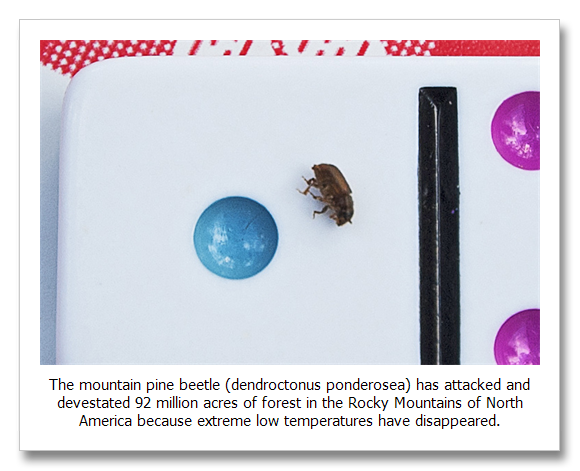
It was hoped that the last several years of wet and cold in the Rockies would put a damper on the great pine beetle infestation ongoing. In 2008, the infestation increased 18 million acres. The last record breaking pine beetle infestation in North America was three million acres in ten years. This event ended about…
A new mega report by the International Union of Forest Research Organizations states the obvious. Persistent drought, insect infestations and disease have increased just as the scientists predicted they would over 20 years ago. These problems have already had enormous impacts on the forests of the world and those impacts are increasing in severity and…
A study in Nature last month confirmed ongoing increased CO2 storage in tropical forests – on the gigaton scale – that’s a lot. So the CO2 fertilization effect is confirmed? Yes of course, we new this all along, CO2 is a fertilizer. But in reality the benefits of the CO2 effect have already been surpassed…