Category

Abrupt changes

2 Degrees C., 1 Degree C. or 0 Degrees C.?

By Abrupt changes, Climate Policy, Climate Reform, economics, Forest Mortality, Legacy Policy, Strategy, Temperature

Two degrees C was first suggested as an upper limit to where we should allow our climate to warm by Nordhaus (Yale) in the American Economic Review in 1977 with the justification that this amount of change would exceed the temperature envelope where our mature civilization has developed. Nordhaus cites Sellers 1974 and NCAR 1974…

Read More

Critical Climate Time Frames: New Strategy is Needed

By Abrupt changes, alternatives, Climate Policy, Climate Reform, Negative emissions, Sea Level Rise, Solutions, Strategy

Scientists have been planning for how to implement a transformation to an alternative energy infrastructure for more than several years now. Jacobson 2013, represents years of effort and others have been doing the same. We know how to evolve our energy infrastructure, how long it will take, how much it will cost, and how efficient…

Read More

An Easier Solution to Climate Change

By Abrupt changes, adaptation, aerosols, alternatives, Climate Policy, climate pollutants short-lived, Climate Reform, CO2 Removal and Sequestration, economics, Extreme Weather, in-depth and Popular Press, Sea Level Rise, Shifting Ecology, Strategy, Temperature, What we can do

The driver of our climate system has changed in the last two decades from one that is controlled by annual emissions, to one that is controlled by already emitted CO2. This means that previous strategies to control annual emissions are no longer meaningful and we must now turn our attention to the already emitted climate…

Read More

What is Important and Why? A Zero-Warming Healthy Climate

By Abrupt changes, aerosols, alternatives, Climate Policy, Climate Reform, CO2 Removal and Sequestration, economics, Emissions, Negative emissions, Solutions, Strategy

For 24 years we have been attempting to implement climate reform, but because strategies are complex, controversial and inequitable, we have nothing to show for this effort save a near-failing carbon credit program in the EU. By giving ourselves permission to seek zero warming, we go beyond the failed strategies of the past into a…

Read More

NOAA — Ice Sheet Collapse in Our Time: Zero Warming Climate Solution

By Abrupt changes, adaptation, Climate Policy, CO2 Removal and Sequestration, Emissions, Emissions Scenarios, ice sheets, in-depth and Popular Press, modeling, Negative emissions, Sea Level Rise, Solutions, West Antarctic Ice Sheet

We have delayed too long and now must urgently reduce the load of warming gases already emitted to our sky. We have been warned this would happen for decades, we just didn’t think it would happen so soon. This is exceedingly bad news, though the good news with climate change is very good indeed. The…

Read More

Sea Level Rise 500 BC to 2000: The Sea Level Rise Hockey Stick

By Abrupt changes, Beach Report, Beaches coastal, Oceans, Sea Level Rise

The Devil’s Elbow, Padre Island National Seashore. This is that point where the Texas Coast trends from Northeast to south; the big bend of coastal Texas. “The oceans are rising the beaches decree. Gonna get covered up by the sea. Tide gauges say what we can’t see. The oceans are rising the beaches decree.” Beaches…

Read More

The Beetles: 6,000 Miles of Climate Change — Long Version

By Abrupt changes, Drought, forest health, Forest Mortality, Impacts, pine beetle, Shifting Ecology, Vegetation Response

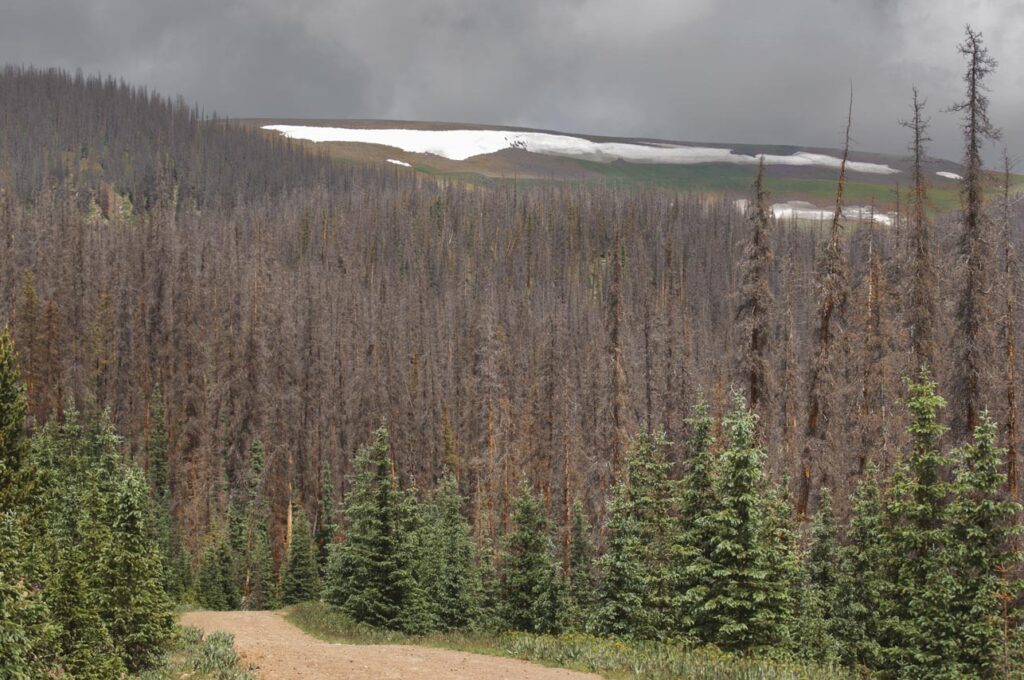
This is the original long version with much more detail and all of the destinations and forest health descriptions along the 6,000 mile route. The abbreviated  2,000 word version was published on Truthout on February 16, 2016 is here. We were awash for 19 days in a tumultuous sea of mountains and forests, drifting a course through the heart…

Read More

More on the Shutdown of the Gulf Stream

By Abrupt changes, Gulf Stream, ice sheet, ice sheets, Impacts, Oceans

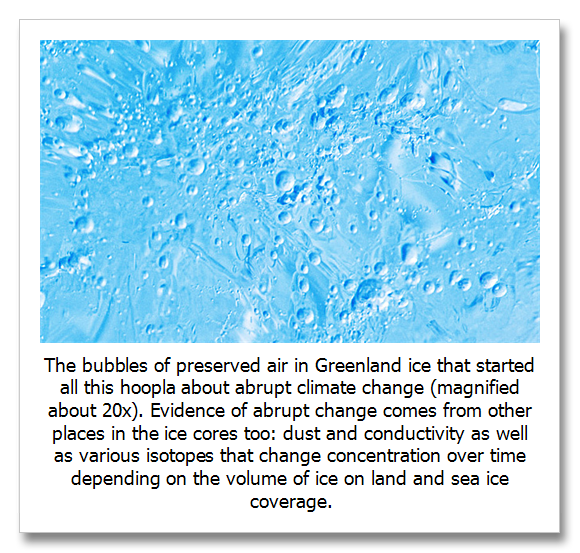
Dansgaard Oeschger climate variability, more easily remembered as abrupt climate change, has been known from across the world through numerous lines of investigation since the early 1990s. This research greatly increases the robustness of the theory that a freshwater cap in the far North Atlantic from melting ice plays a significant role in abrupt change….

Read More

A Generation of Delay: Climate Policy Is 20 Years Behind

By Abrupt changes, aerosols, alternatives, Climate Policy, CO2 Removal and Sequestration, Deniers and Delayers, in-depth and Popular Press, Negative emissions, Psycho, Solutions

First Published on Truthout, December 4, 2015 The perceived debate on climate change has discredited traditional climate science communications to such an extent that we are just now implementing policies developed during the Kyoto Protocol era that began in 1992. New climate science knowledge is simply not making it out of academia and into public…

Read More

There All Along: “Exceptional” Slowdown of the Gulf Stream From Greenland Melt

By Abrupt changes, Glaciers, Gulf Stream, Oceans, Truthout.org

First Published on Truthout, April 13, 2015. The Gulf Stream plays an immensely important role in moderating the climate of eastern North America and Europe. Moreover, Greenland melt impacts ocean current processes in the North Atlantic. For years, contradictory research has alternately said the Gulf Stream was slowing and that it was not slowing. The…

Read More

Climate Change 2014: What Do We Do Now?

By Abrupt changes, aerosols, alternatives, Climate Policy, climate pollutants short-lived, CO2 Removal and Sequestration, Emissions, Emissions Scenarios, Negative emissions, Solutions, Truthout.org

First published on Truthout, December 26, 2014. As we move into 2015, the latest climate science continues to diverge from policy. New science tells us that, because of short-lived climate pollutants, current policies dealing with carbon dioxide pollution alone will likely produce more warming than doing nothing at all. Complete Article

Read More

With This Decade’s Climate Policy, Expect More Warming Than if Nothing Was Done at All, by Bruce Melton

By Abrupt changes, Climate Policy, climate pollutants short-lived, CO2 Removal and Sequestration, Emissions, Emissions Scenarios, in-depth and Popular Press, Methane, Temperature, Truthout.org

First Published on Truthout, August 27, 2014 (link) The fundamental climate change policy question today is not how much we should reduce carbon dioxide emissions by when, but what will currently proposed carbon dioxide emissions reductions do to our climate in the near-term? In addition, what are the ramifications of short-lived climate pollutants that are…

Read More

Optimal Path for Avoiding Dangerous Change and Short-lived Greenhouse Gases

By Abrupt changes, Methane, Uncategorized

Methane (and natural gas), and black carbon (soot) are short-lived greenhouse gases relative to carbon dioxide, N20 (nitrous oxide) and CFC (chlorofluorocarbons). Limiting these short-lived greenhouse gases have obvious benefits in reducing warming. Focusing emissions reductions on these gasses also gives the benefit of delaying warming in the short-term, but really only in a world…

Read More

Welcome to Climate Change Texas Part “Extra”: The Worst-Case Scenario is Happening

By Abrupt changes, Climate Catastrophes, Deniers and Delayers, Extreme Weather, Impacts, in-depth and Popular Press, Temperature

                (This article is an expansion of and provides technical backup for Bruce Melton’s three-part series, “Welcome to Climate Change in Texas,” published in December 2011 and January 2012 on The Rag Blog.) Read More — Extra:  Welcome to Climate Change Texas: The Worst-Case Scenario is Happening (expansion and backup) Part…

Read More

Welcome to Climate Change Texas Part 1: What Can Be Done About Climate Change in Texas?

By Abrupt changes, Agriculture, alternatives, Climate Catastrophes, Deniers and Delayers, Drought, forest health, Forest Mortality, Impacts, in-depth and Popular Press, rainfall, Solutions

As I have been saying in the first two installments of this series, climate change is already much more extreme than most scientists have been predicting. This is mainly because the majority of predictions are based on the “most likely” emissions scenario and because we have not reduced our emissions like climate scientists told us…

Read More